
Virat Kohli Draws Criticism for Cautious Batting as Health Concerns Cloud His IPL 2026 Form
Authored by destined2win.net, 15 Apr 2026
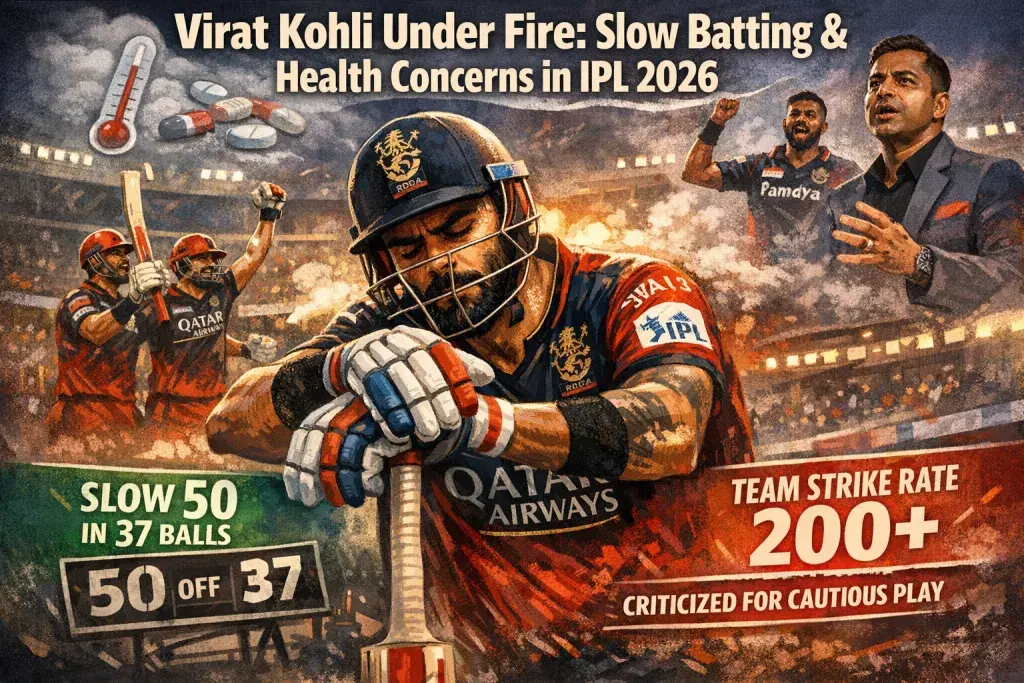
A half-century completed in 37 deliveries, surrounded by teammates striking at rates above 200 — Virat Kohli's knock against Mumbai Indians has drawn pointed criticism from commentators and raised broader questions about expectation, context, and the physical demands placed on high-profile cricketers performing through illness. Royal Challengers Bengaluru secured a convincing win, but the debate over Kohli's contribution has refused to stay quiet.
A Knock That Divided Opinion
Analyst and former cricketer Aakash Chopra addressed the innings directly, describing it as out of step with the demands of the format. "Virat Kohli actually scored very slow runs," Chopra said. "If you look at it in the context of the match, you feel it doesn't matter as you won. But if you see it from a cricketing lens, it was a very slow knock. This kind of knock is unbecoming of the contest, and neither is it becoming of Virat." The criticism is notable coming from Chopra, whose commentary is generally measured. He did not dismiss the win — he questioned the method.
The contrast within the same batting unit was stark. Every other batter operating that evening maintained a strike rate above 200. Kohli did not cross 150. He was dismissed off the very delivery after reaching his fifty, caught off Hardik Pandya, which meant his measured approach did not ultimately yield extended value for the side either.
The Health Factor and Its Limits as a Defence
The fuller picture includes a significant detail: Kohli was reportedly managing a high fever and severe headache in the hours before the contest. He did not take the field during the opposition's innings — a visible signal of compromised physical condition. Playing through illness at an elite level carries genuine physiological costs. Fever impairs neuromuscular coordination, reaction time, and decision-making capacity. That Kohli batted at all, and scored runs, carries its own weight.
Yet this context only partially deflects Chopra's point. Professional performance environments rarely offer the luxury of managing expectations against personal health circumstances, and Kohli, more than most, has built a public identity around disciplined physical readiness. The expectation of peak output follows him regardless of circumstance. When that output falls visibly below the standards of his own teammates on a given evening, the conversation becomes inevitable.
Kohli's Broader IPL 2026 Arc Offers a More Balanced View
Isolating one innings from a broader body of work produces distorted conclusions. Across IPL 2026, Kohli has maintained a strike rate of approximately 162 — a figure his own historical record confirms as an improvement on previous seasons. For a batter who spent years absorbing criticism for conservative run-scoring in the shortest format, that shift is meaningful. It reflects deliberate adaptation: adjusting footwork, shot selection, and intent to align with what the format now demands.
T20 batting has evolved rapidly. The acceptable baseline for strike rate has shifted upward across the entire professional landscape, driven by stronger bowling attacks, more aggressive field-setting, and a generation of power-hitters who have redrawn what is possible. A strike rate of 162, considered strong by historical standards, now sits below the cutting edge. Kohli's adaptation has been real — but the format has kept moving.
What the Debate Reveals About Expectation and Accountability
The volume of attention directed at a single below-par innings inside a winning cause says something about where Kohli sits in the public imagination. Criticism of this kind is not purely analytical — it is also a measure of the standard he has set over two decades. The same innings from a lesser-known batter would attract little scrutiny. From Kohli, it becomes a referendum on whether he still belongs at the apex of the format.
That is both the burden and the compliment of sustained excellence. Aakash Chopra's critique was precise and fair within its own terms. The fuller truth is more layered: a player managing illness, still contributing runs in a convincing win, against a backdrop of the best strike-rate season of his IPL career. One evening does not define the arc — but it does reveal how narrowly elite performers are now being watched, and how little margin for imperfection remains at the highest level.